Chinese chip advances rattle global markets and test ASML's monopoly
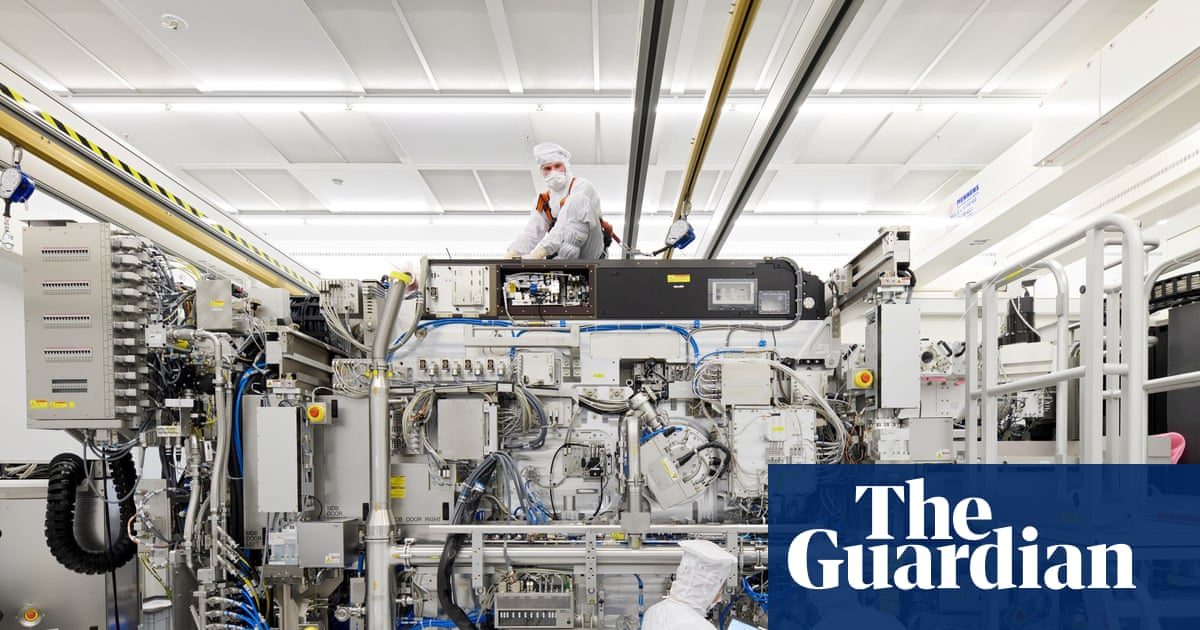
A record-breaking Shanghai IPO and reports that Beijing has replicated ASML's lithography technology triggered a global sell-off in AI-linked stocks, exposing how fragile investor confidence has become around the sector.
A single week upended the AI trade. On Monday, Chinese memory chipmaker CXMT listed in Shanghai and surged 466%, reaching a valuation of 3.3 trillion yuan (£365bn). The same day, reports emerged that China had developed its own deep-ultraviolet lithography tools — the precision laser systems that until now only the Dutch firm ASML could build.
The reaction was swift and severe. South Korea's Kospi index shed 11.5% on Tuesday and another 6% on Wednesday, dragged down by SK Hynix and Samsung Electronics. By Thursday, the Nasdaq had briefly entered correction territory, dropping more than 10% from its recent peak. Nvidia lost over 5% and was overtaken by Apple as the world's most valuable listed company.
Friday brought a partial reprieve. Strong earnings from Amazon and Microsoft steadied nerves, and the Kospi rebounded nearly 20% in a single session. Even so, the Korean index booked its worst month since October 2008.
ASML's structural moat
For European investors, the lithography story carries the most weight. Deep-ultraviolet machines etch the finest circuit lines into silicon wafers, and ASML's exclusive command of that technology has underpinned its market position for years.
Yet analysts urged calm. Alvin Nguyen of Forrester noted that semiconductor fabrication plants "still take years to develop." Mark Boost, chief executive of UK cloud firm Civo, called the sell-off an overreaction to short-term risk. "Manufacturing a handful of machines is a massive symbolic victory, but not a commercial replacement for ASML overnight," he said. "Until these Chinese tools can match western reliability, ASML's global dominance remains structurally safe outside mainland China."
Memory, not muscle
CXMT's spectacular debut also deserves context. The company produces DRAM chips, which store data for AI processors but do not compete with the graphics processing units that Nvidia designs. In a market facing a global DRAM shortage expected to persist until 2030, CXMT arguably eases supply constraints rather than threatening Western chip leaders.
Nguyen called the sell-off in memory names like SK Hynix and Micron an "overreaction," arguing that existing producers cannot meet demand regardless of new entrants.
The Nvidia concentration problem
Underlying the volatility is a deeper unease: the AI economy leans heavily on one company. Reports that Nvidia was weighing a $250bn backstop for an OpenAI datacentre project — roughly six months after a $100bn deal between the two collapsed — added to jitters. Morningstar identified the story as a significant factor in Nvidia's weekly decline.
Chris Beauchamp, chief market analyst at IG, warned that Chinese chip firms may eventually "undercut and outcompete on price," as they have in steel and automobiles. Nguyen was blunter about the long arc: "At some point in the future, they'll no longer be one of the most valuable companies in the world. Maybe they'll be worth only $2tn."
Whether last week's swings were an overreaction or a preview, the episode laid bare a market struggling to price an opaque, circular AI economy anchored to a single firm.